

Everything You Need to Know About Euro Pallets: Dimensions, Standards and Differences Explained

Pallets are everywhere: in warehouses, on lorries and in supermarkets. They are an essential part of modern logistics, keeping goods moving quickly, safely and efficiently. The best-known and most widely used type is the Euro pallet, at least across Europe.
In this article, you will find everything you need to know about Euro pallets: exact dimensions, differences to other pallet types, standards and certifications, and of course how much they cost.
What are the dimensions of a Euro pallet?
The Euro pallet, also known as the EUR pallet, is the most widely used pallet in Europe and is manufactured to the standards of the European Pallet Association (EPAL). It is a standardised wooden pallet.
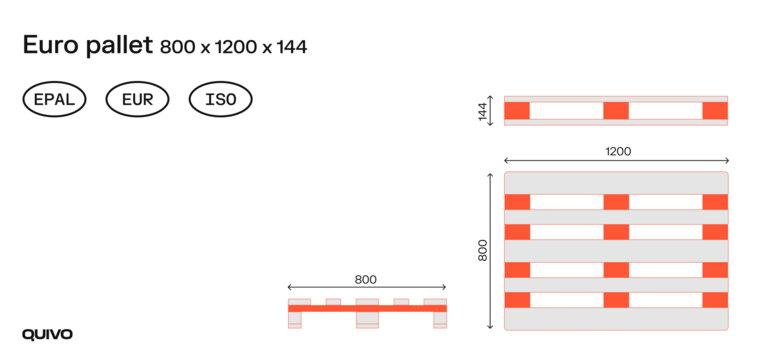
The dimensions of a Euro pallet are 1200x800x144 mm:
- Length: 1,200 mm | Width: 800 mm | Height: 144 mm
- Weight: approx. 25 kg (depending on the type of wood and its moisture content)
Euro pallet sub-sizes:
- Half Euro pallet (800 x 600 mm): This smaller version of the Euro pallet is ideal for more compact storage and product displays.
- Quarter Euro pallet (600 x 400 mm): Commonly used as a display pallet in retail to present smaller goods directly on the shop floor.
- Third pallet (800 x 400 mm): A less common size, suited to specific industry applications and space-saving transport.
Construction:
A Euro pallet consists of eleven boards, nine blocks and 78 specialist nails. It can carry loads of up to 1,500 kg. These dimensions were chosen to make the best possible use of space in transport vehicles such as lorries and containers.
Markings:
The Euro pallet is certified to international standards, including ISO 6780, which defines standard pallet sizes. This makes it a recognised and standardised means of transport both in Europe and worldwide. Every Euro pallet carries the EUR mark on its blocks, clearly identifying its type. It may also carry the EPAL logo.
Like the 1,200 x 1,000 mm industrial pallet, the Euro pallet with its dimensions of 1,200 x 800 mm also complies with the ISO standard and is overseen by the European Pallet Association (EPAL).
Sustainability:
Wooden pallets, and Euro pallets in particular, are relatively environmentally friendly as they are made from renewable materials and are recyclable. They can be used multiple times and, at the end of their life cycle, recycled or processed into new pallets.
Why does the Euro pallet exist?
The Euro pallet was introduced in the 1960s, as the European economy grew and cross-border trade increased. Varying pallet sizes were causing inefficiencies in transport and storage processes.
To address this, European railway companies joined forces to develop a common pallet standard. The Euro pallet was created to:
- Simplify transport processes: standardised dimensions make loading and unloading lorries, trains and ships much easier.
- Reduce costs: standardisation allows storage space to be used more efficiently and cuts handling times.
- Improve compatibility: companies can exchange pallets without having to worry about differences in size or quality.
The advantages of the Euro pallet
- Standardisation: simplifies international trade through uniform dimensions.
- Robustness: withstands heavy loads and can be used multiple times.
- Environmental friendliness: wood is a renewable raw material and the pallets are recyclable.
- Cost efficiency: reduces storage and transport costs through optimal use of space.
The role of the Euro pallet in logistics
The Euro pallet is more than just a wooden platform. It is a central component of modern supply chains. Its standardisation enables:
- Efficient warehouse management: racking systems are designed around Euro pallet dimensions.
- Automation: conveyor systems and packaging machinery are built to handle Euro pallets.
- Global connectivity: the Euro pallet is recognised and used outside Europe too, making global trade easier.
How much does a Euro pallet cost?
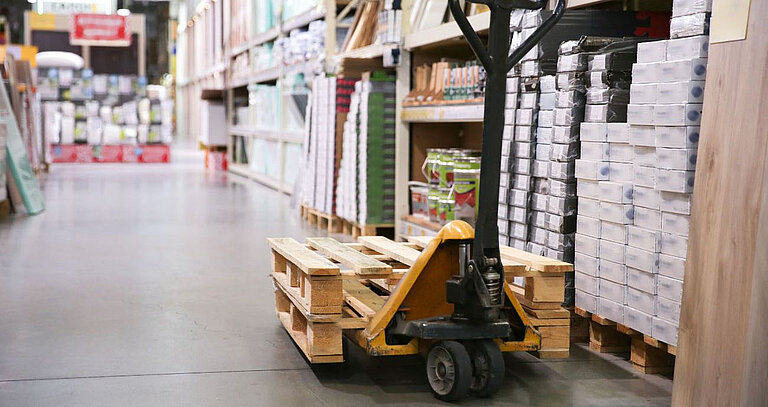
Pallets can be ordered in large quantities through specialist dealers or online marketplaces such as Amazon Business, as well as from local pallet suppliers. Prices vary depending on condition and supplier:
- New Euro pallets: between £15 and £25 per unit, available from specialist pallet dealers or directly from manufacturers.
- Used Euro pallets: from £5 upwards, depending on condition and wear. Available from pallet dealers, some wholesalers or online platforms such as eBay.
- Pallet hire: some logistics providers offer the option to hire pallets, which saves on costs and storage space.
Comparison: the 10 most common pallet types
Euro pallet / EUR pallet
- Dimensions: 1,200 x 800 mm
- Use: the standard across Europe and widely used.
Industrial pallet / ISO pallet / American pallet
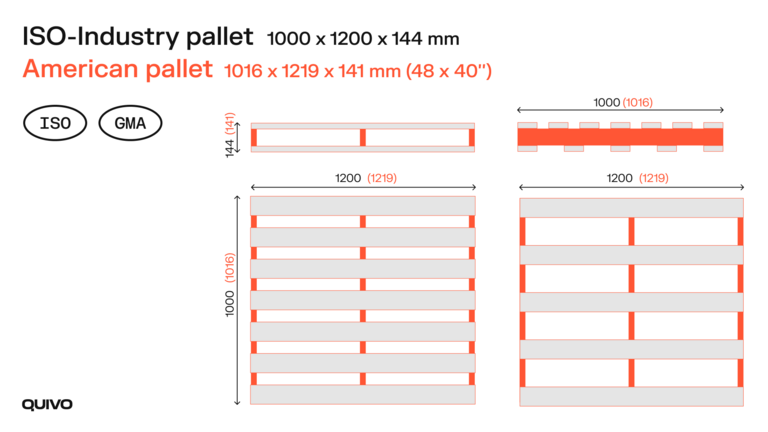
- Dimensions: 1,200 x 1,000 mm
- Use: used in industry, particularly for larger goods.
- Also widely used in the USA, with near-identical dimensions of 1,219 x 1,016 mm.
Half Euro pallet / Düsseldorf pallet / display pallet
- Dimensions: 800 x 600 mm
- Use: commonly used in retail for fast turnover.
Single-use pallet
- Dimensions: varies; most common sizes are 1,200 x 800 mm or 1,200 x 1,000 mm
- Use: designed for one-off transport, cost-effective.
Mini pallet
- Dimensions: typically 400 x 300 mm
- Use: compact and ideal for retail displays.
XXL pallet / large pallet
- Dimensions: variable, e.g. 2,000 x 1,200 mm
- Use: suited to large and bulky goods.
Plastic pallet
- Dimensions: varies; most common sizes are 1,200 x 800 mm or 1,200 x 1,000 mm
- Use: hygienic and frequently used in the food and pharmaceutical industries.
Barrel pallet
- Dimensions: 1,200 x 1,200 mm
- Use: designed for transporting barrels.
Container pallet
- Dimensions: 1,140 x 1,140 mm
- Use: ideal for container transport. A widely used size across Asia.
ISO pallet
- Dimensions: varies; 1,200 x 1,000 mm and 1,200 x 800 mm are ISO standards
- Use: international standard pallet, varying by region.


Standards and certifications for pallets
Organisations and companies such as EPAL, IPPC and GMA help ensure the quality and safety of pallets in international trade, particularly for the ever-present Euro pallet. Requirements vary by region:
- EPAL (European Pallet Association) sets strict guidelines for the manufacture and repair of Euro pallets to maintain a consistent standard and enable smooth pallet exchange between companies.
- GMA (Grocery Manufacturers Association) is a trade body representing food manufacturers in the United States, advocating for consistent pallet standards. Although the GMA is not directly responsible for pallet certification, it has influence over the logistics and transport of goods. The American pallet, which differs only slightly from the ISO-standardised industrial pallet, is GMA certified.
- ISO standards: international standards such as ISO 15620 set out requirements for pallet design and performance.
- IPPC certification (International Plant Protection Convention) is required for the export of wooden packaging such as pallets to many countries and is designed to prevent the spread of harmful organisms.
- CHEP is a major pallet provider with its own quality standards, working closely with EPAL.
- TIMBER certification is a complementary certification to EPAL, confirming the origin and quality of the wood used.
Why are there so many certifications and organisations?
- Quality assurance: certifications help maintain a consistently high standard and prevent damage to transported goods.
- Traceability: pallet markings allow for end-to-end tracking, making supply chain monitoring easier.
- Phytosanitary protection: IPPC certification is designed to prevent the spread of pests and diseases.
- Trade facilitation: uniform standards make cross-border trade smoother.
Definition: what exactly is a pallet?
- A pallet is a flat, rectangular platform on which goods can be stacked, stored and transported. It makes handling goods much easier and allows for more efficient transport, as it is designed to work with lorries, forklifts and other lifting equipment.
- Pallets are made from a range of materials, including wood, plastic, metal and cardboard, with wooden pallets being the most common.
- Euro pallets are pallets with specific dimensions that are ISO standardised and widely used both in Europe and beyond. They follow the European pallet standards set by EPAL and are marked with the EUR or EPAL symbol.
- Beyond the Euro pallet, there are a number of other pallet types and sizes for different applications. These include the American pallet, which is GMA certified and similar in size to the ISO-standardised industrial pallet, as well as the display pallet, block pallet, container pallet, mini pallet and several other standardised types.
- Now you should have a solid understanding of Euro pallets and pallets in general. If you have any further questions or are looking for a fulfilment provider, feel free to get in touch. We will get back to you with a no-obligation quote.
Sources
Grocery Manufacturers Association Website
iso.org (International Organization for Standardization)
Pictures: Unsplash
Quivo © 2026
Insights into the world of flexible fulfillment
ARTICLES
ARTICLES
Insights into the world of flexible fulfillment



Ready to grow?
With our scalable fulfillment solution.
Let’s work together