

Incoterms 2020 Explained: All 11 Rules at a Glance (2026)
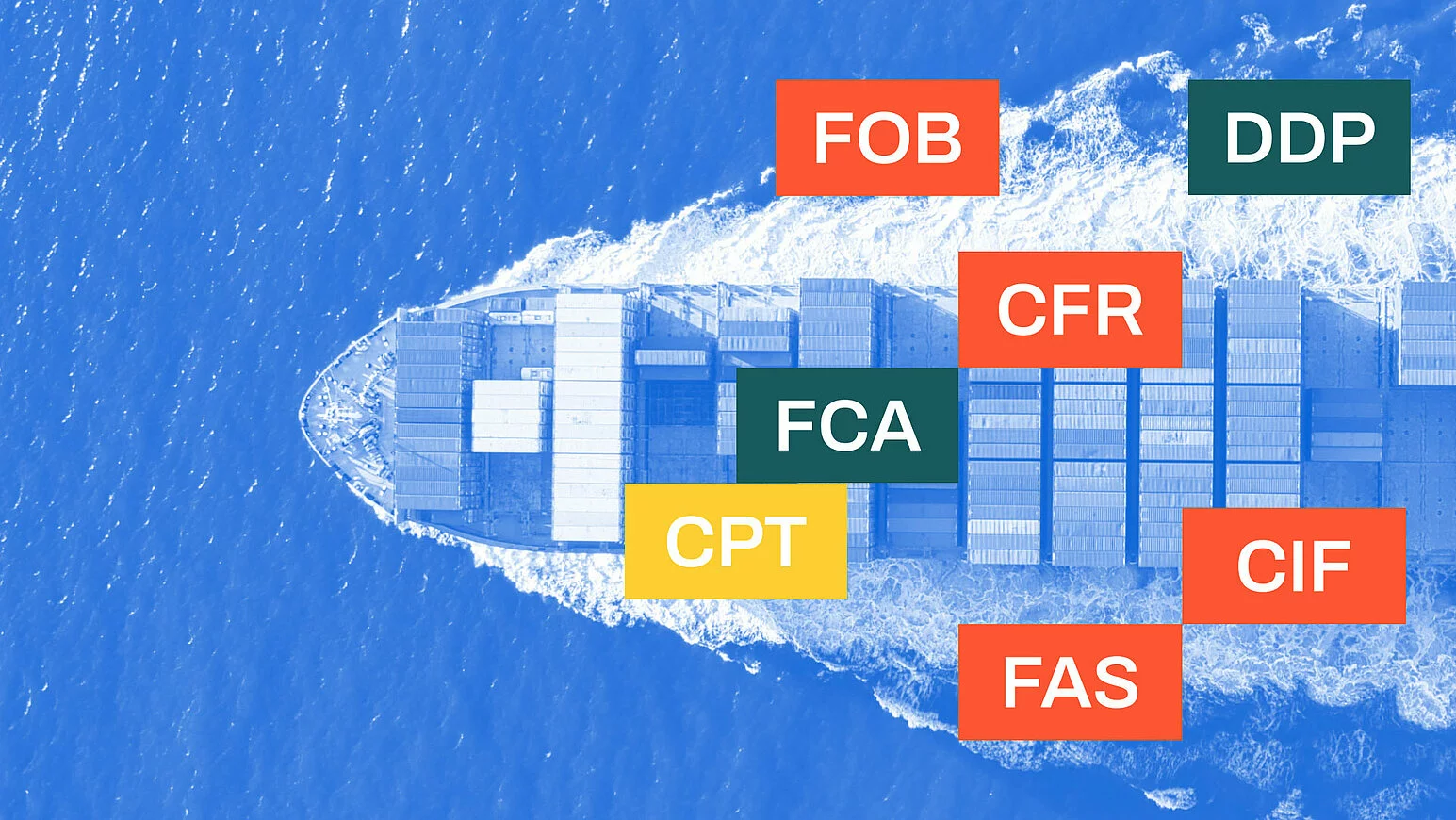
Clear rules and standards are essential in international trade. This is exactly where Incoterms come in: standardised terms that clearly define responsibilities, obligations and risks in cross-border transactions.
In this article, we explain what Incoterms are in simple terms. You will get a complete overview of all the rules, what they mean and the benefits they bring. With practical examples, we also show you which Incoterms are the best fit for your business. Let’s get started!
- What are Incoterms? Their meaning explained simply
- Quick overview: Incoterms at a glance
- The categories and groups of Incoterms
- List of all Incoterms, with definitions and practical examples
- What changed with Incoterms 2020?
- How to use Incoterms correctly in a contract
- How to choose the right Incoterms for your business, with examples
- Incoterms in e-commerce: DAP or DDP?
- The benefits of Incoterms
- FAQs
What Are Incoterms 2020? Their Meaning Explained Simply
Incoterms, short for “International Commercial Terms”, are globally recognised rules that define the obligations of buyers and sellers in the international sale of goods. They clarify who is responsible for what, above all:
- the time and place of delivery,
- risks and insurance,
- costs and
- customs clearance.
Incoterms were introduced by the International Chamber of Commerce (ICC) in 1936 and have been a key part of international trade ever since. Since 1980, the rules have been revised roughly every ten years, most recently in 2010 and 2020. They are recognised by importers, exporters, freight forwarders and carriers worldwide.
- Incoterms 2020 are currently in force. They have applied since 1 January 2020 and remain valid until a new version is published. The ICC is already working on Incoterms 2030, which are due to be published in late 2029.
- Important: you can still agree on older versions such as Incoterms 2010, as long as you name them explicitly in your contract, for example “FCA Hamburg, Incoterms 2010”.
- According to the ICC, Incoterms are today the globally recognised standard for international sales contracts.
Good to know: A new version does not automatically replace the old one. Your contract determines which version applies. That is why you should always include the year, for example “DAP Vienna, Incoterms 2020”.
In essence, Incoterms answer and simplify common questions such as:
- When do the goods pass from the seller to the buyer?
- Who pays which transport costs?
- Who is liable for loss of or damage to the goods, from which point, and who covers the insurance costs?
Incoterms: Quick Overview
A compact overview of all Incoterms. You will find more information and examples further down.
| Rule | Applies to | Key feature |
|---|---|---|
| EXW | All modes of transport | Minimum obligation for the seller |
| FCA | All modes of transport | Buyer nominates the carrier |
| CPT | All modes of transport | Seller pays freight, risk passes early |
| CIP | All modes of transport | Like CPT, but with comprehensive insurance |
| DAP | All modes of transport | Delivery at named place, not unloaded |
| DPU | All modes of transport | Delivery including unloading |
| DDP | All modes of transport | Seller covers everything, including duties |
| FAS | Sea and inland waterway only | Delivery alongside the ship |
| FOB | Sea and inland waterway only | Delivery on board the ship |
| CFR | Sea and inland waterway only | Seller pays freight, risk passes on loading |
| CIF | Sea and inland waterway only | Like CFR, but with minimum insurance |
The Categories and Groups of Incoterms
There are 4 groups of Incoterms:
E term: EXW (Ex Works), also known as the “pick-up term”
EXW is the right choice if the buyer is to bear all transport costs and risks from the seller’s premises. From that point, the buyer pays for everything, and responsibility passes to them as soon as the goods are ready for collection at the seller’s site.
F terms: main carriage not paid by the seller
F terms work well if the buyer wants to take on the costs and risks of the main carriage only. “Free” here means that the buyer covers the costs from a certain point, while the seller bears the risk and costs up to that point.
C terms: main carriage paid by the seller
C terms are usually chosen when the seller pays the transport costs to the destination. The seller pays for transport to a named place, but the risk passes to the buyer as soon as the goods are handed over to the first carrier.
D terms: arrival terms
These make sense when the seller bears the transport costs to the destination. Responsibility and risk pass to the buyer once the goods have arrived at the destination and are made available there.
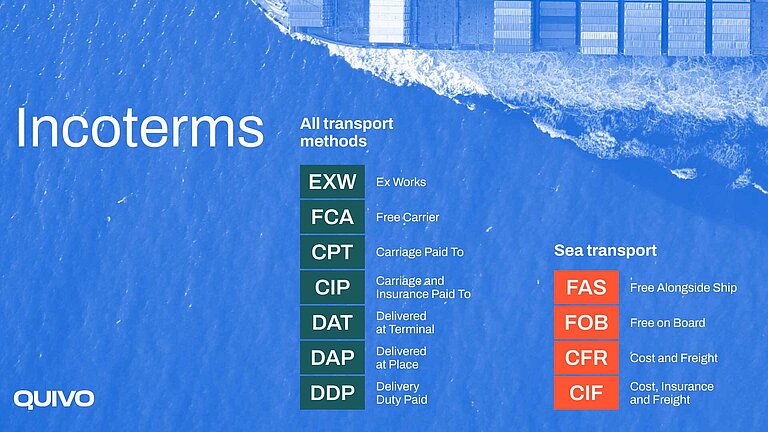
List of All Incoterms, With Definitions and Practical Examples
The following rules apply to all modes of transport:
- Road and rail transport
- Air freight
- Sea and inland waterway transport
- Combined or multimodal transport
The Incoterms:
EXW (Ex Works)
The seller makes the goods available at its premises or another named place, such as a factory, plant or warehouse. From that point, the buyer bears all costs and risks.
Example: A German machinery manufacturer sells a machine to a company in Japan. The machine is made available at the seller’s plant in Munich. The Japanese buyer must collect the machine and arrange transport to its own site, including all transport, insurance and customs costs.
FCA (Free Carrier)
The seller delivers the goods to a carrier nominated by the buyer or to another named place. The seller is responsible for export customs clearance.
Example: A French wine producer delivers wine to a retailer in the US. The wine is handed over to a freight forwarder in Bordeaux nominated by the retailer. The producer bears the costs and risks until handover to the forwarder; everything after that is the retailer’s responsibility.
CPT (Carriage Paid To)
The seller pays the freight costs to the named destination. However, the risk passes to the buyer as soon as the goods have been handed over to the first carrier.
Example: An electronics manufacturer in China sells tablets to a retailer in Australia. The manufacturer pays the transport costs to the port of Sydney. However, the risk of loss or damage already passes to the buyer at the port of Shanghai.
CIP (Carriage and Insurance Paid To)
As with CPT, the seller pays the freight costs to the destination, but the risk passes to the buyer as soon as the goods are handed over to the first carrier. In addition, the seller must take out transport insurance with comprehensive cover under the Institute Cargo Clauses (A). This is the key difference from CIF, where minimum cover under Clauses (C) is enough.
Example: A furniture manufacturer in Italy sells a consignment of chairs to a customer in Canada. The manufacturer pays the freight and insurance costs to the destination in Toronto. The risk passes to the buyer once the goods are handed over to the first carrier, but the seller takes out comprehensive transport insurance under Clauses (A), which covers almost all damage on the way to Toronto.
DAP (Delivered at Place)
The seller delivers the goods to a named place, without unloading. The seller bears all costs and risks up to that point.
Example: A German engineering company sells a production line to a customer in Brazil. The line is delivered to the customer’s plant in São Paulo. The German seller bears all transport costs and risks until the line arrives at the Brazilian customer’s plant.
DPU (Delivered at Place Unloaded)
The seller bears the costs and risks until the goods have been unloaded at the named place. This is the only rule under which the seller is also responsible for unloading.
Example: A Spanish furniture manufacturer delivers a large order to a furniture retailer in London. The goods are transported to the retailer’s warehouse in London and unloaded there. The Spanish manufacturer bears all costs and risks until the goods have been unloaded at the warehouse.
DDP (Delivered Duty Paid)
The seller bears all costs and risks up to delivery at the named place, including import clearance. The buyer only has to accept the goods. For online retailers shipping goods from outside the EU to customers in the EU, DDP has become even more important since mid-2026. Since 1 July 2026, the duty exemption for consignments worth up to €150 no longer applies. Instead, a flat customs duty of €3 per tariff classification is charged. For example, three blouses made of two different materials in one parcel cost €6 in duty. Under DDP, the seller pays these costs. Under DAP, the buyer does, which in B2C often means your end customer. For now, the rule applies to consignments declared via IOSS.
Example: An electronics manufacturer in South Korea sells TVs to a retailer in Germany. The manufacturer bears all costs and risks until the TVs are delivered to the retailer’s warehouse in Berlin, including payment of all customs duties and taxes.

Rules for sea and inland waterway transport only:
FAS (Free Alongside Ship)
The seller delivers the goods alongside the ship at the port of shipment. From that point, the buyer bears all costs and risks.
Example: A Canadian timber supplier sells timber to a customer in Spain. The timber is placed alongside the ship at the port of Vancouver. From that point, the Spanish buyer bears the costs and risks of transport.
FOB (Free On Board)
The seller loads the goods onto the ship nominated by the buyer at the port of shipment. The risk passes to the buyer as soon as the goods are on board.
Example: A Brazilian coffee supplier sells a large quantity of coffee to a trader in the US. The coffee is loaded at the port of Santos onto the ship nominated by the US trader. From that point, the trader bears all risks and costs.
CFR (Cost and Freight)
The seller pays the costs and freight to the port of destination. However, the risk passes to the buyer as soon as the goods are on board the ship.
Example: An Indian textile manufacturer sells fabrics to a buyer in the UK. The manufacturer pays the transport costs to the port of Liverpool. However, the risk for the goods already passes to the British buyer at the port of Mumbai.
CIF (Cost, Insurance and Freight)
Like CFR, but the seller must also take out transport insurance. Minimum cover under the Institute Cargo Clauses (C) is enough, which only covers certain risks such as fire, stranding or collision. If you as the buyer need more protection, you must expressly agree on higher cover or take out additional insurance yourself.
Example: A Japanese car manufacturer sells cars to a dealer in South Africa. The manufacturer pays the transport and insurance costs to the port of Cape Town. The risk passes to the buyer as soon as the cars are on board, and the seller takes out transport insurance with minimum cover. If the buyer in Cape Town wants comprehensive protection, this must be agreed separately.
What Changed With Incoterms 2020?
Compared with the previous 2010 version, Incoterms 2020 brought several important changes:
- DPU replaces DAT: The former rule DAT (Delivered at Terminal) is now called DPU (Delivered at Place Unloaded). Goods can now be unloaded at any place, not just at a terminal.
- Higher insurance under CIP: Under CIP, the seller must now take out comprehensive insurance under the Institute Cargo Clauses (A). CIF still only requires minimum cover under Clauses (C).
- FCA with an on-board bill of lading: Under FCA, the buyer and seller can agree that the carrier issues the seller with a bill of lading bearing an on-board notation. This is especially important for payments by letter of credit.
- Own means of transport: Under FCA, DAP, DPU and DDP, the buyer or seller may also transport the goods with their own vehicles, without engaging an external carrier.
- Security requirements: The rules now state explicitly who bears the costs of security-related requirements in transport and customs clearance.
- Clearer cost allocation: All costs borne by the seller and the buyer are now listed together in one place, which makes the rules easier to understand.
How to Use Incoterms Correctly in a Contract
For an Incoterms rule to be clear, it always needs three pieces of information:
- the rule, for example FCA
- the exact place, ideally with an address, for example “Havenweg 12, 3011 AB Rotterdam”
- the version, i.e. “Incoterms 2020”
Correct: FCA Havenweg 12, 3011 AB Rotterdam, Netherlands, Incoterms 2020
Unclear: FCA Rotterdam
The more precise the place, the clearer it is where costs and risk pass from one party to the other.
How Are Incoterms Applied, and What Do They Not Cover?
International trade is a complex web of regulations, responsibilities and agreements. Incoterms are one of the keys to simplifying this complexity. These standardised contract terms play a crucial role in defining the obligations of buyers and sellers in global trade. They provide clear guidelines that reduce misunderstandings and make trade more efficient.
In essence, Incoterms determine who takes care of the following:
- Commercial documents: Who is responsible for obtaining the required documents for the goods? Who pays for them?
- Transport documents: Who has to obtain the necessary transport documents? Who bears the cost of preparing them?
- Insurance: Who is responsible for insuring the goods during the various stages of transport? Who pays the insurance costs?
- Information: Who is responsible for providing the trading partners with which information, and when?
- Inspection: Who inspects the goods? Who pays for the inspection?
- Packaging: How should the goods be packed? Who pays for the packing process and packaging materials?
The following points are NOT explicitly covered by Incoterms and should therefore always be defined separately in the contract:
- Payment terms: Who sets the payment terms, and which jurisdiction applies in the event of a legal dispute?
- Transfer of ownership (not the same as transfer of possession!): When does ownership of the goods pass to the buyer, and how does this differ from the transfer of possession?
- Breach of Incoterms: What happens if one party fails to meet its obligations under the Incoterms?
- Liability: Which exclusions of liability apply to both parties?
- Replacement deliveries: Who is responsible for replacement deliveries if the original delivery is damaged or lost?
Incoterms are an indispensable tool in international trade. They provide a clear and precise basis for handling cross-border transactions and help reduce risks and misunderstandings. By clearly defining the obligations and responsibilities of buyers and sellers, they support a smooth and efficient trading process.
How to Choose the Right Incoterms, With Practical Examples
Here are some key aspects and benefits to consider when choosing and using Incoterms, so you can operate as efficiently as possible in international business:
Analysing Your Needs
- Type of goods: Consider whether the goods are fragile, valuable or perishable. Example: fresh food needs fast and secure transport conditions.
- Transport route: Decide whether the goods will travel by ship, plane, truck or train. Example: heavy freight is often shipped by sea, while urgent goods are sent by air.
Cost and Risk Allocation
- Cost allocation: Decide which partner bears which transport and insurance costs. Example: the seller could pay the costs up to the port, with the buyer taking over from there.
- Transfer of risk: Clarify at which point the risk passes from the seller to the buyer. Example: under EXW (Ex Works), the buyer bears all risks from the seller’s premises.
Responsibilities
- Commercial documents: Define who obtains and pays for the required documents. Example: the seller provides the export documents, the buyer takes care of the import paperwork.
- Transport documents: Clarify which party obtains which transport documents and bears the costs. Example: the seller obtains the consignment note, the buyer arranges the contract of carriage.
- Insurance: Decide who insures the goods for which stages of transport.
- Example: Under CIP, the seller insures the goods with comprehensive cover up to the destination; under CIF, only with minimum cover. None of the other rules include an obligation to insure, so you should clarify yourself who covers which stage of transport.
Information and Communication
- Notifications: Agree on who informs whom about what. The seller must notify the buyer in good time when the goods have been delivered or are ready. Under F terms such as FCA or FOB, the buyer must tell the seller the carrier, place of delivery and time of delivery.
- Documents: Clarify who provides which documents, for example the commercial invoice, proof of delivery, transport document or certificate of origin.
- Customs and security information: Since Incoterms 2020, the rules explicitly state that the parties must assist each other with the information needed for customs and security checks. They also set out who bears the costs.
- Example: A retailer in Nuremberg sells spare parts FCA Nuremberg to a customer in Canada. The Canadian buyer must tell the seller in good time which forwarder will collect the goods and when. The seller confirms the handover and provides the export documents. If any of this information is missing, the goods sit in the warehouse, and the costs of the delay can quickly become a point of dispute.
Packaging
- Packaging requirements: Define how the goods should be packed. Example: sensitive electronics must be packed to withstand impact.
- Packaging costs: Decide who pays for packaging and packaging materials. Example: the seller pays for standard packaging, the buyer for additional protective measures.
Legal Aspects
- Payment terms: Define the payment terms and the jurisdiction for any disputes. Example: payment is due after delivery, and the jurisdiction is the seller’s country.
- Transfer of ownership: Distinguish between the transfer of possession and the transfer of ownership. Example: ownership passes on payment, possession on delivery.

Incoterms in E-Commerce: DAP or DDP?
For online retailers selling to customers in other customs territories, or importing goods from abroad, two rules matter most: DAP and DDP.
- Under DAP, the seller delivers to the customer’s door, but the recipient pays customs duties and import taxes. In B2C, this means your customer has to pay extra on delivery, which often leads to refused deliveries and returns.
- Under DDP, the seller also covers customs duties, import VAT and clearance. This is the most convenient option for the customer, but means more effort and cost for you.
This question has become even more important since 1 July 2026. The EU has abolished its duty exemption for consignments worth up to €150. Instead, e-commerce consignments declared via IOSS are now subject to a flat customs duty of €3 per tariff classification. If you sell DDP, you need to build these costs into your prices. If you sell DAP, you pass them on to your customers.
The EU is not alone. The US suspended its $800 de minimis exemption for all countries in August 2025, and the UK has announced that its £135 customs duty relief will end by March 2029 at the latest.
- You can find out more about the difference between the two rules in our article DDP vs DAP.
Why Use Incoterms? The Benefits at a Glance
- International recognition: Incoterms are recognised worldwide and ensure consistent trading practices.
- Standardisation: They provide clear, uniform rules that prevent misunderstandings.
- Greater efficiency: A clear division of tasks makes the trading process faster and smoother.
- Lower risk: Clear rules reduce the risk of disputes.
- Cost transparency: Businesses can plan and control their costs more effectively.
By using the right Incoterms for your business, you make sure your international transactions run smoothly, securely and cost-efficiently.
Any questions? Get in touch with us anytime!
Sources
E-commerce fulfilment services
ICC Austria: Incoterms® 2030
ICC Academy: Incoterms® 2020, CIP or CIF?
customs-declarations.uk: The EU’s €3 duty on low-value e-commerce imports
UK Government: “Choose which Incoterms are right for you”: great.gov.uk
Pictures:
Unsplash
pixabay
Quivo © 2026
Insights into the world of flexible fulfillment
ARTICLES
ARTICLES
Insights into the world of flexible fulfillment

Ready to grow?
With our scalable fulfillment solution.
Let’s work together